
Making a personal site readable to LLMs

8 min read
I came across this via an AI Engineer talk by Christopher Burns from Inth: How We Got LLMs to Recommend Our Open Source Library.
The short version is that if you want ChatGPT, Perplexity, or Claude to mention your project, you cannot only optimize for Google. You have to make the site readable to the bots that feed those models.
The talk is about a library. I do not have a library. I have emasuriano.com, a small Astro 5 site on Cloudflare Pages: who I am, the open source I ship, and some writing. I wanted to know how far the same idea goes on a personal site, without turning the homepage into a product landing page.
The constraint I set at the start, and kept: do not change the visible homepage. The hero stays two lines. “I’m a Software Engineer at Revolut.” “I contribute to Open Source, and write about web development.” That is the whole pitch. If a scorecard wanted a /developers portal, a contact form, or 500 extra characters of HTML, the scorecard would have to live with a C.
Two scorecards, two personalities
I used two scorecards, and they do not agree on how “product-like” a personal site should be.
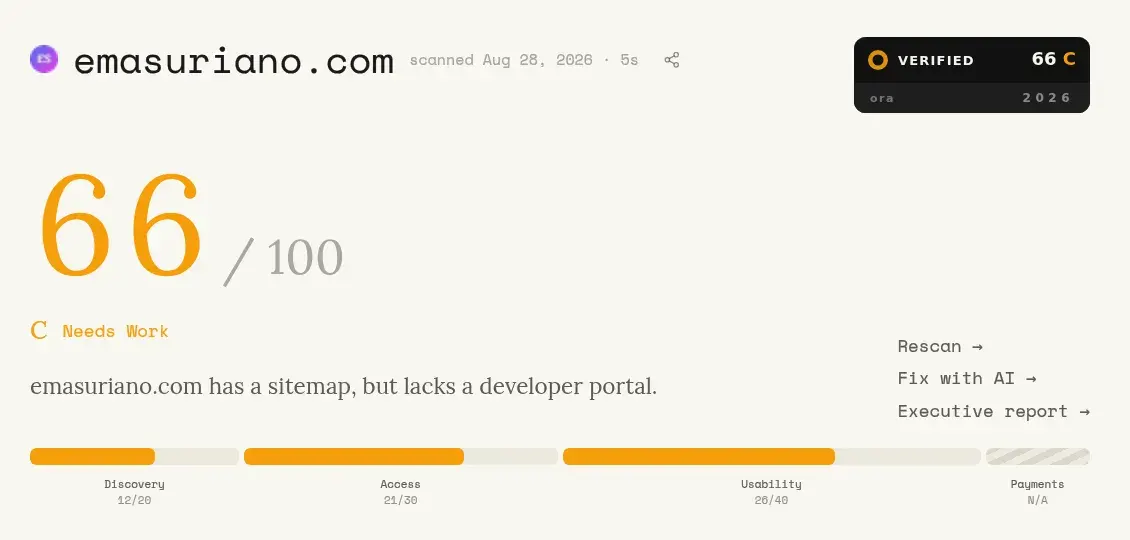
Ora (orank) treats the site like a SaaS. It wants API keys, MCP, OAuth, SDKs, a developer portal. First scan, 27 Aug: 11/100 (F). After llms.txt, robots.txt, Person JSON-LD, and unique titles went live: 22. After a real /sitemap.xml plus the Cloudflare dashboard allowlist: 52. Same afternoon, an Ora export with a different layer breakdown: 53. The scan from 28 Aug at 07:06 UTC, which is what the public Ora page shows now: 66/100 (C).

is-agentic is not a second crawler. It re-weights the same Ora evidence, and it is kinder to a homepage that is a person. Same timestamp as the 66 scan: 90/100. The remaining fails were mostly “add more homepage copy”, “add a /developers portal”, and “add contact + privacy”. In other words: become a product.
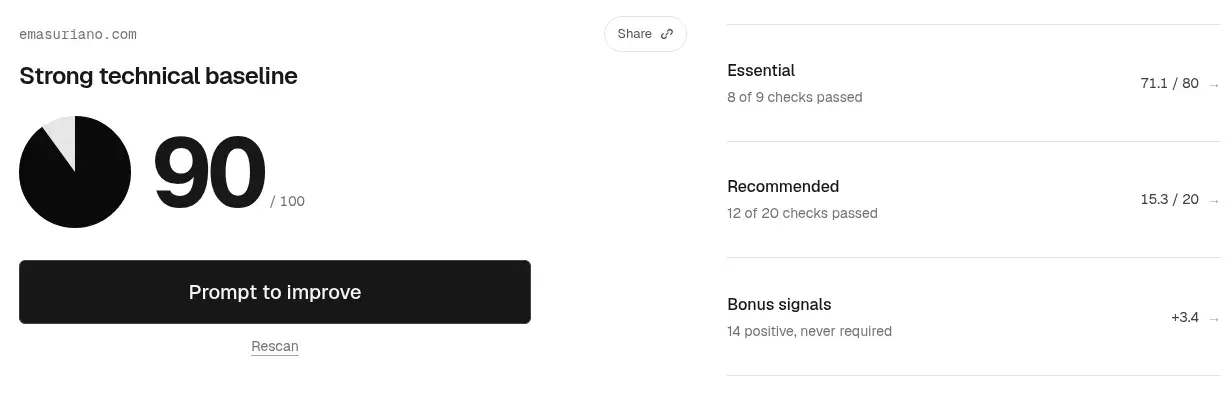
I treated Ora as a noisy dashboard and is-agentic as a second reading of the same evidence. Neither is the goal. The goal is that an agent can fetch who I am, what I wrote, and which projects are mine, without executing a bundle of JavaScript.
What actually moved the needle
All of 11 to 52 happened on the afternoon of 27 Aug, in this order.
1. Stop blocking the new crawlers
robots.txt was the obvious first file. I allow GPTBot, ChatGPT-User, OAI-SearchBot, ClaudeBot, Claude-User, PerplexityBot, Perplexity-User, Google-Extended, Applebot-Extended, Amazonbot, and ora-agent. I still disallow CCBot and Bytespider. Then a catch-all User-agent: * / Allow: /.
On top of that I generate /llms.txt and /llms.md from author.json. Same content, two content types. That file is the version of the site I wish a model would read: who I am, when the site is useful, pages, API, projects, posts, talks, social.
2. Tell machines I am a person, not a blank HTML document
Person + WebSite JSON-LD, unique titles, canonical URLs, and a markdown alternate. Later I added Berlin and LinkedIn on the Person node. I did not invent an email or a phone number so Organization.contactPoint would look “complete”. If a crawler wants to reach me, the LinkedIn URL is the contact point.
That first bundle took Ora from 11 to 22. Not enough to care.
3. Ship a sitemap that is actually a sitemap
robots.txt pointed at /sitemap.xml. The live file for a while was Astro’s /sitemap-index.xml. In one of the broken states, a redirect 308’d into HTML. Ora looked at that, shrugged, and decided I had no sitemap.
The fix was a real /sitemap.xml urlset, and listing both that and sitemap-index.xml in robots. Boring, and it mattered.
4. The Cloudflare dashboard, not more files
This was the jump from 22 to 52, together with the sitemap, and it was not a pull request.
The site is on Cloudflare Pages. Bot Fight Mode and a blanket “block AI bots” rule were eating GPTBot and friends before they ever saw robots.txt or llms.txt. I allowed AI search/agent bots in the dashboard and turned the fight-mode hammer off.
Files I had already shipped started counting. If your agent-readiness score is stuck after you added llms.txt, check whether your WAF is eating the crawler. That was the same afternoon.
5. Document the APIs I already had
I already had GET /api/summary and GET /api/posts. They were not a product API. They were JSON for the site. I added an OpenAPI spec for those two endpoints, plus a short /api.md, and listed both in llms.txt.
No fake MCP server. No OAuth. No SDK. No CLI. No sandbox. Scorecards love those checkboxes. A personal site does not need them, and adding a toy version would have been lying.
6. Serve markdown when the client asks for it
Browsers still get HTML. Clients that send Accept: text/markdown on / get the same body as /llms.md.
Static Astro cannot negotiate that on its own, so a Cloudflare _worker.js does it. Same worker later started serving /.well-known/agent-skills/index.json. I had put that file under public/.well-known, but the dot-directory never reached dist, so production 404’d until the worker served it.
That is the one place where crawlers and humans see different bytes, and it is content negotiation, not hidden homepage text. I will come back to that.
7. Make the JSON actually JSON
Prerendered extensionless API files were coming out as application/octet-stream. 404s were HTML. There was no /api/v1, no cursor pagination, no RateLimit headers.
The worker now:
- serves
application/json - returns JSON 404s (RFC 9457 problem+json)
- exposes
/api/v1/summaryand/api/v1/posts - paginates posts with a cursor
- sends rate-limit headers
8. Stop dumping the entire blog into /api/posts
This one is embarrassing. GET /api/posts used to return full markdown bodies. About 770KB of JSON to answer “what has this person written”.
It now returns a small array of id, collection, slug, url, and data.{title,summary,publishedAt}. A few kilobytes. If an agent wants the article, it can fetch the article.
What I refused
Ora still fails, or half-fails, a set of checks that all say the same thing: pretend you are Stripe.
I closed the pull requests that would have:
- padded the homepage to 500+ characters of visible HTML
- linked
/api/*from the homepage - added a Contact page
I also refused hidden sr-only copy so a crawler would see text a human did not. That never became a PR.
The homepage HTML is still about 152 characters of visible text. is-agentic calls that out. I am fine with it. Hidden text to game a “content without JS” check is cloaking, and I do not want that on a site with my name on it.
Markdown on Accept: text/markdown is the legitimate version of “give agents more than the hero”. Humans in a browser still get the same two lines.
I also refused to invent an email address for schema.org. Berlin + LinkedIn was as far as I was willing to go.
Where the scores landed
| Scanner | Last look | Grade |
|---|---|---|
| Ora | 66/100 (28 Aug, 07:06 UTC) | C |
| is-agentic | 90/100 (same timestamp) | — |
Ora is still mad about the missing developer portal. is-agentic is still mad about the short homepage. Both of those are the constraint working as designed.
The useful outcome is not the letter grade. An agent can now:
- Read
robots.txtand not get WAF’d - Fetch
/llms.mdorAccept: text/markdownon/ - Walk a real sitemap
- Hit
/api/v1/summaryand/api/v1/postsas JSON - Discover skills at
/.well-known/agent-skills/index.json
If Perplexity or ChatGPT ever cite this site, it will be because those files exist, not because I added a fake MCP server.
What I would skip next time
If I were doing this again on another personal site, I would do the Cloudflare allowlist first, then robots.txt, then a real sitemap, then llms.txt. The OpenAPI and pagination work is nice, and it made the existing APIs less of a footgun, but it is not what took the score from F to something I can live with.
I would still skip the homepage essay. The whole point of this site is that it is small. Teaching a crawler to read a small site is more interesting than making the site bigger so the crawler is less confused.
The repo
Everything lives in EmaSuriano/portfolio. Astro 5, Cloudflare Pages, a worker for the bits static files cannot do. The homepage is still two lines.